[Seasonal Offer] Unconventional Armaments
Unique ground, naval and air vehicles – in seasonal offers only!
Seasonal Offers
Commanders! 🚩 From January 13th to January 20th, 2026 (ends at 07:00 GMT), as part of a Seasonal Offer, a new set of unique premium vehicles will be available to you. After completing special Seasonal Challenges, you will be able to purchase it with a maximum discount:
- In the Tank Campaign: Freccia + 4 Keys for the Big Trophy from the “Lightning Strike” season + Back-ups x5, Repair Kits x100, Medical Kits x100, Fire Extinguishers x50.
- In the Ship Campaign: IJN Kitakami + 1 Key for the Big Trophy from the “Lightning Strike” season + Smoke Generators x250 + Naval Supply x250.
- In the Aviation Campaign: F-84G-21-RE + 4 Keys for the Big Trophy from the “Lightning Strike” season + Back-ups x10.
Freccia (Rank XI)
Historical note
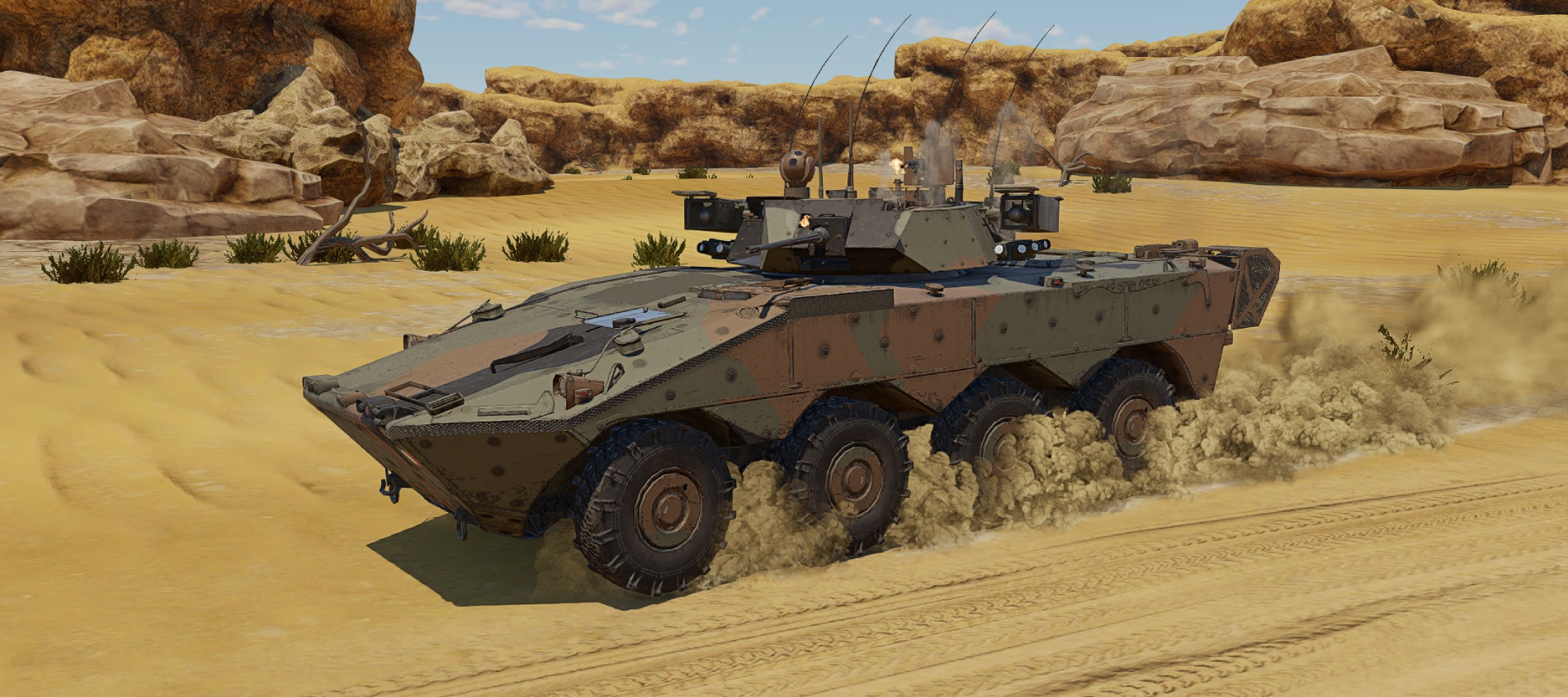
The Freccia VBM infantry fighting vehicle was developed for joint operations alongside the Centauro wheeled tanks. It shares their chassis and is designed to transport infantry while providing effective fire support.
The vehicle’s key feature is the upgraded HITFIST Plus turret, equipped with an automatic 25 mm Oerlikon cannon and a coaxial machine gun. To engage armored targets, the turret is also fitted with launchers for Spike anti-tank guided missiles. The vehicle entered service with the Italian Army in 2009.
SWOT Analysis
- Strengths: Equipped with fire-and-forget Spike missiles with a tandem-charge warhead, a fast-firing 25 mm cannon, and high mobility.
- Weaknesses: Lightly protected; missiles are less effective at very close range.
- Opportunities: Functions as a fast wheeled scout capable of employing “smart” missiles for long-range engagements.
- Threats: Highly vulnerable to hits from tank-caliber rounds and autocannons.
In battle
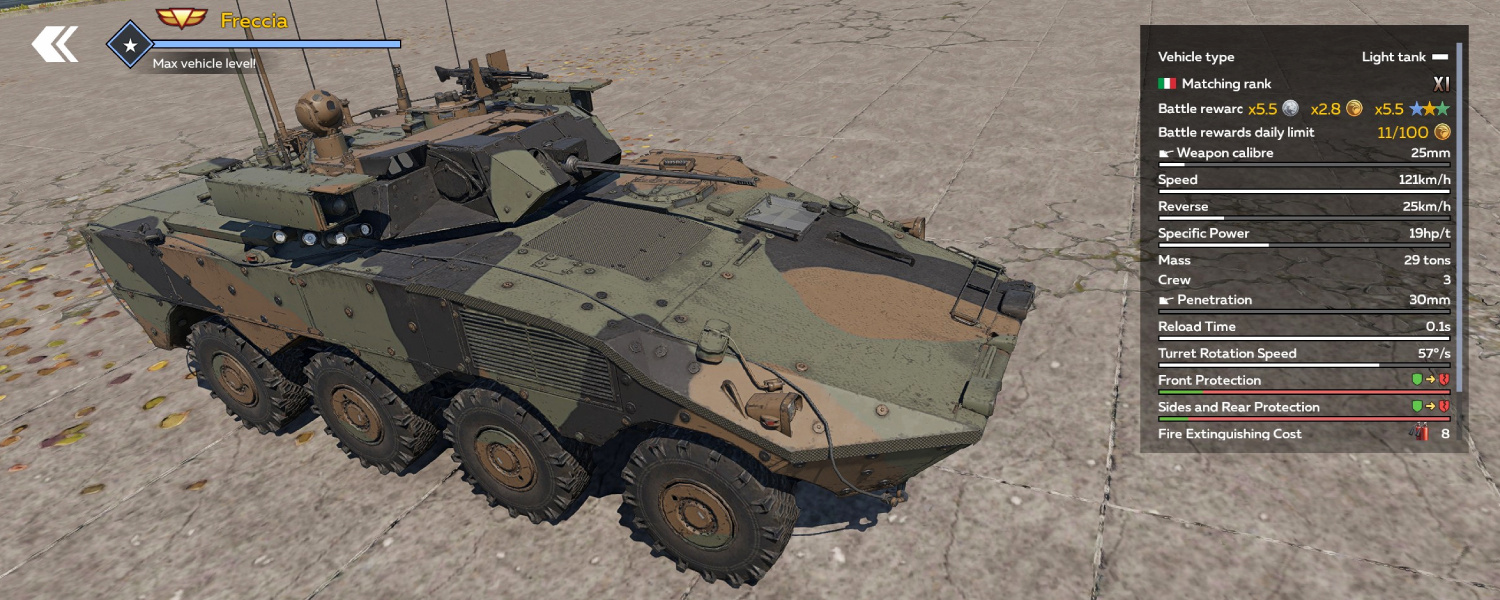
The defining feature of the Italian wheeled scout Freccia is its armament of Spike guided anti-tank missiles, which make their first appearance in War Thunder Mobile. These missiles operate on a fire-and-forget principle, are equipped with tandem-charge warheads capable of defeating explosive reactive armor, and use an imaging infrared seeker for target acquisition.
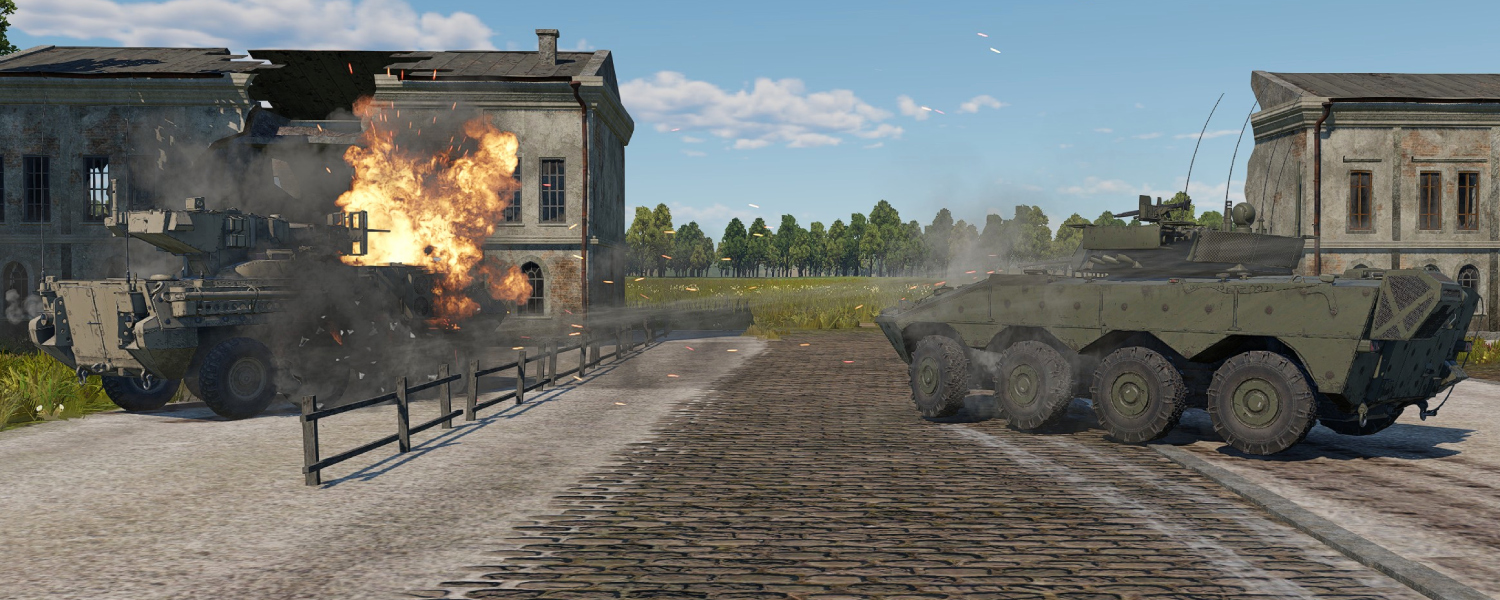
View the characteristics of the Freccia’s shells:
View the characteristics of the Freccia’s shells:
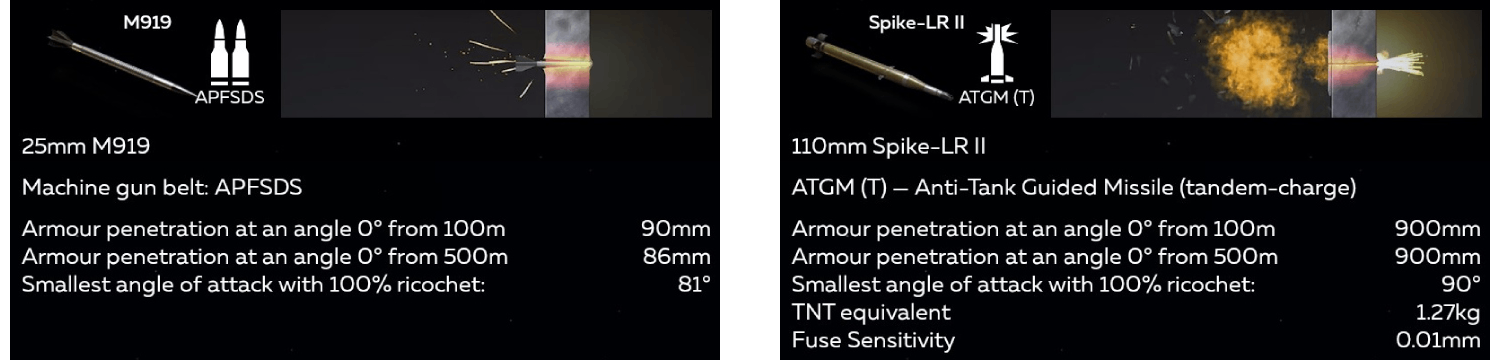
After lock-on and launch, the missile autonomously tracks and engages the target, even if it is moving, by homing in on its thermal signature. After launch, the missile climbs before diving onto the locked target in a top-attack profile. As a result, firing at extremely close range may be ineffective, since the missile may not have sufficient time to complete its attack trajectory.
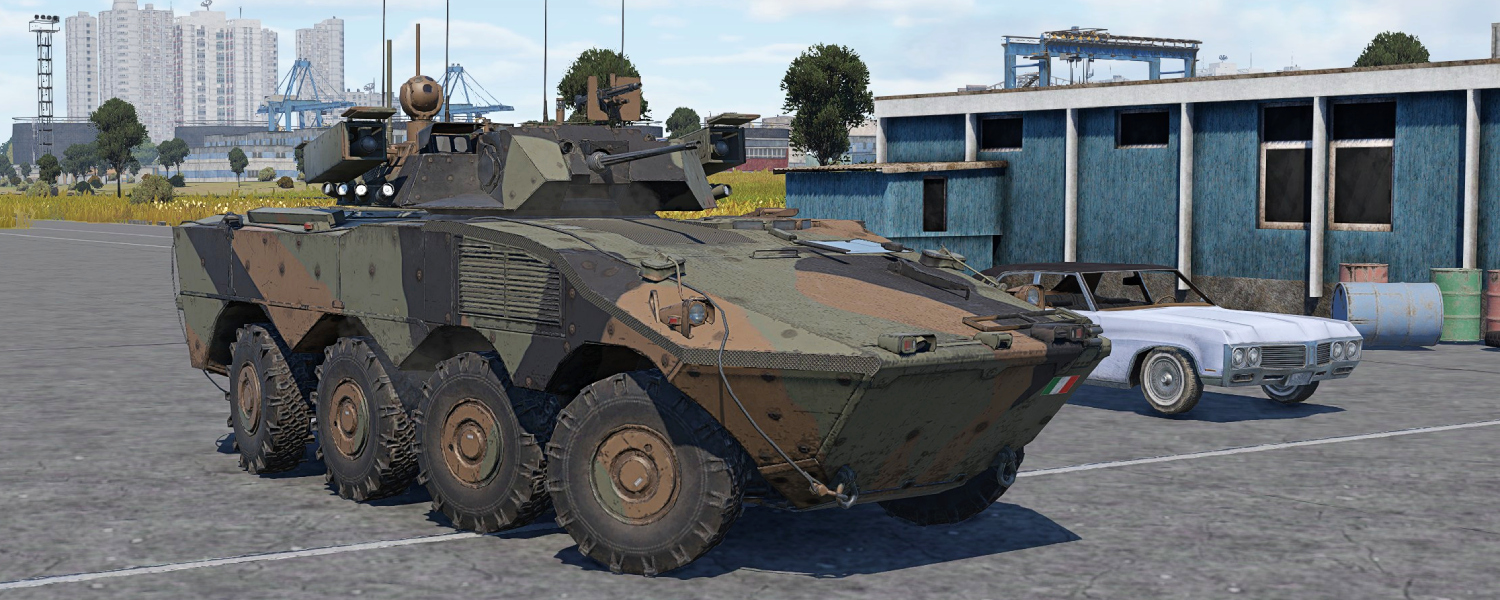
The Freccia is best employed using its high mobility and effective use of cover, as its armor is not designed for direct engagements with heavily armored vehicles. A key vulnerability is the rear troop compartment, which contains the ATGM ammunition. To use the vehicle effectively, maintain constant maneuvering, occupy advantageous firing positions, and relocate quickly after each attack.
IJN Kitakami (Rank II)
Historical note
The light cruiser Kitakami was the third vessel of the Kuma class, constructed between 1919 and 1921 and known for its high speed of up to 36 knots and its main armament of seven 140 mm guns. In August 1941, Kitakami underwent a major conversion into a dedicated “torpedo cruiser,” receiving ten quadruple launchers for the powerful Type 93 “Long Lance” torpedoes in accordance with the Imperial Japanese Navy’s doctrine of night torpedo warfare. On January 27, 1944, off the coast of Malaya, the cruiser was severely damaged after being hit by two torpedoes fired by the British submarine HMS Templar.
After Japan’s surrender, Kitakami was assigned to troop repatriation duties. She was removed from the navy list on November 30, 1945, and subsequently broken up for scrap between 1946 and 1947.
SWOT Analysis
- Strengths: An exceptionally large salvo of powerful 610 mm torpedoes, complemented by good speed.
- Weaknesses: Mediocre main battery firepower for a cruiser.
- Opportunities: Effectively a destroyer disguised as a cruiser, capable of unleashing a devastating torpedo barrage against the enemy.
- Threats: Subpar armor and limited survivability make it vulnerable during prolonged engagements.
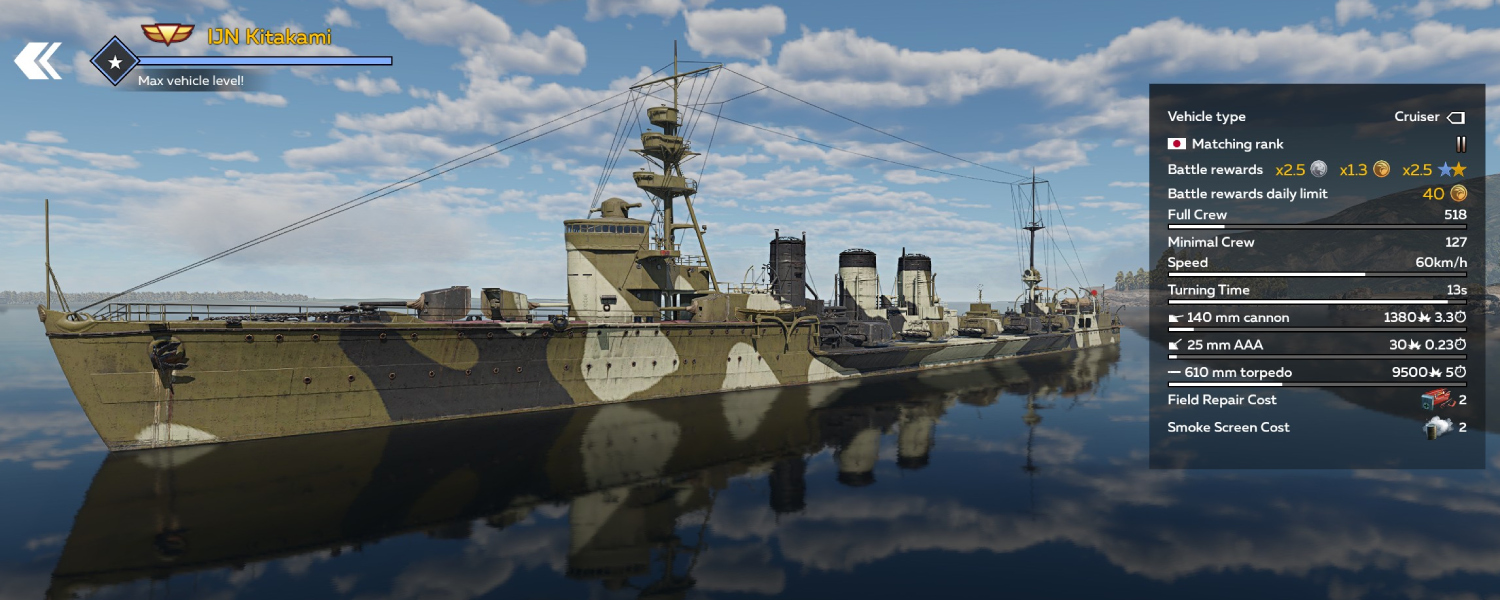
In battle
The IJN Kitakami is a truly remarkable ship. Although classified as a light cruiser, it was designed to lead destroyer flotillas on fast raids, giving it characteristics closer to those of a destroyer. Its greatest distinction lies in its armament: ten quadruple torpedo mounts, five on each side. This is the source of its formidable striking power—the famous “Long Lance” 610 mm Type 93 torpedoes, widely regarded as the most devastating torpedoes of the Second World War. For much of the early and mid-war period, this relatively small vessel carried the heaviest torpedo armament in the world.
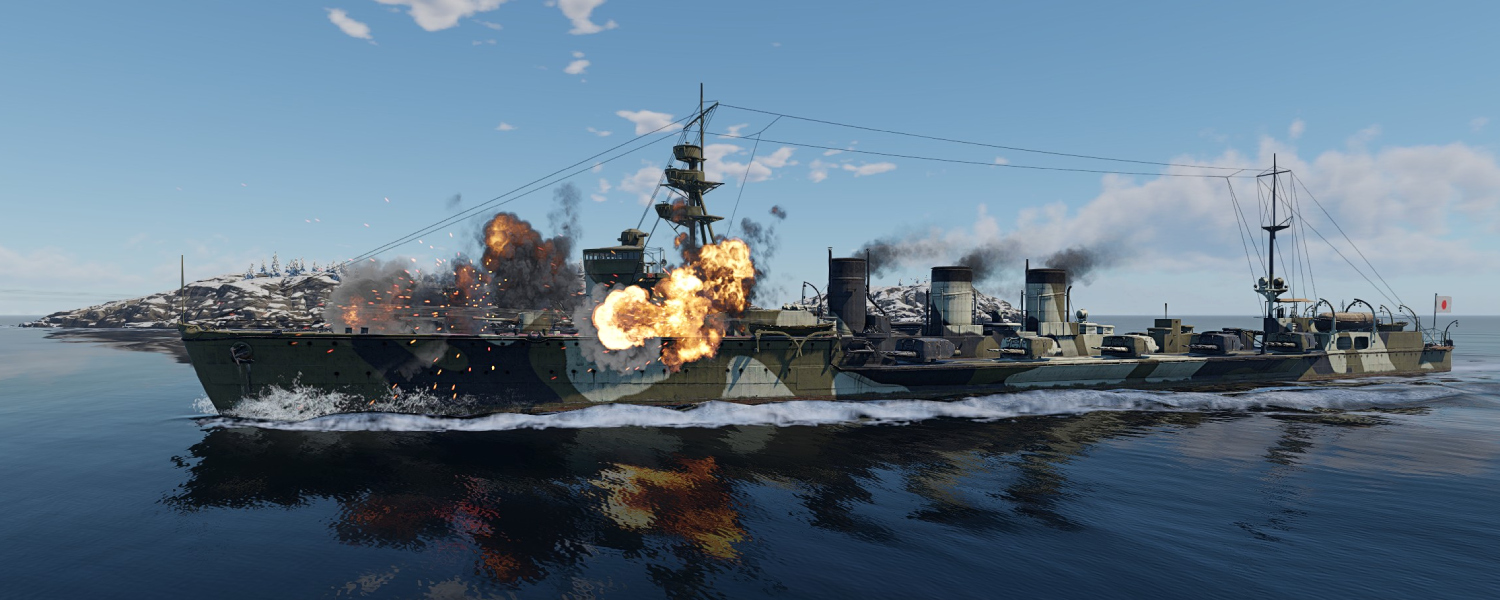
The main battery consists of four 140 mm guns, which is clearly insufficient by cruiser standards. Combined with its light armor, the IJN Kitakami cannot withstand sustained enemy fire, making prolonged gun duels fatal for this unusual cruiser.

The IJN Kitakami is highly agile, making it feel more like a destroyer than a cruiser to play. By rapidly closing the distance or setting up ambushes, Kitakami can unleash colossal damage through massive torpedo salvos. Strike enemy ships with your powerful “Long Lance” torpedoes, then withdraw promptly to avoid return fire.
F-84G-21-RE (Rank IX)
Historical note
Development of the F-84 Thunderjet fighter-bomber began at Republic Aviation in 1944. The prototype made its first flight in 1946, and the aircraft entered service with the U.S. Air Force in 1947. The most advanced and widely produced straight-wing variant was the F-84G, which was adopted in 1951. A defining feature of the F-84G was its ability to carry tactical nuclear weapons, specifically the Mk.7 bomb, making it the world’s first fighter-bomber with this capability.
Approximately 4,500 aircraft of the F-84 Thunderjet family were produced, around 3,000 of which were the F-84G variant. A significant portion of the production was established in NATO countries under the Mutual Security Program. In 1956, Thailand acquired 31 F-84G aircraft from U.S. reserves. The Thunderjet replaced obsolete piston-engine aircraft and became the Royal Thai Air Force’s first jet fighter. Deliveries were carried out between November 1956 and August 1957.
SWOT Analysis
- Strengths: Exceptional speed at all altitudes, a strong rate of climb, and the ability to carry unguided rockets and bombs.
- Weaknesses: Mediocre maneuverability.
- Opportunities: Highly effective in ground-attack missions and capable of engaging enemy aircraft at low and medium altitudes.
- Threats: Vulnerable in turn fights and prolonged dogfights.
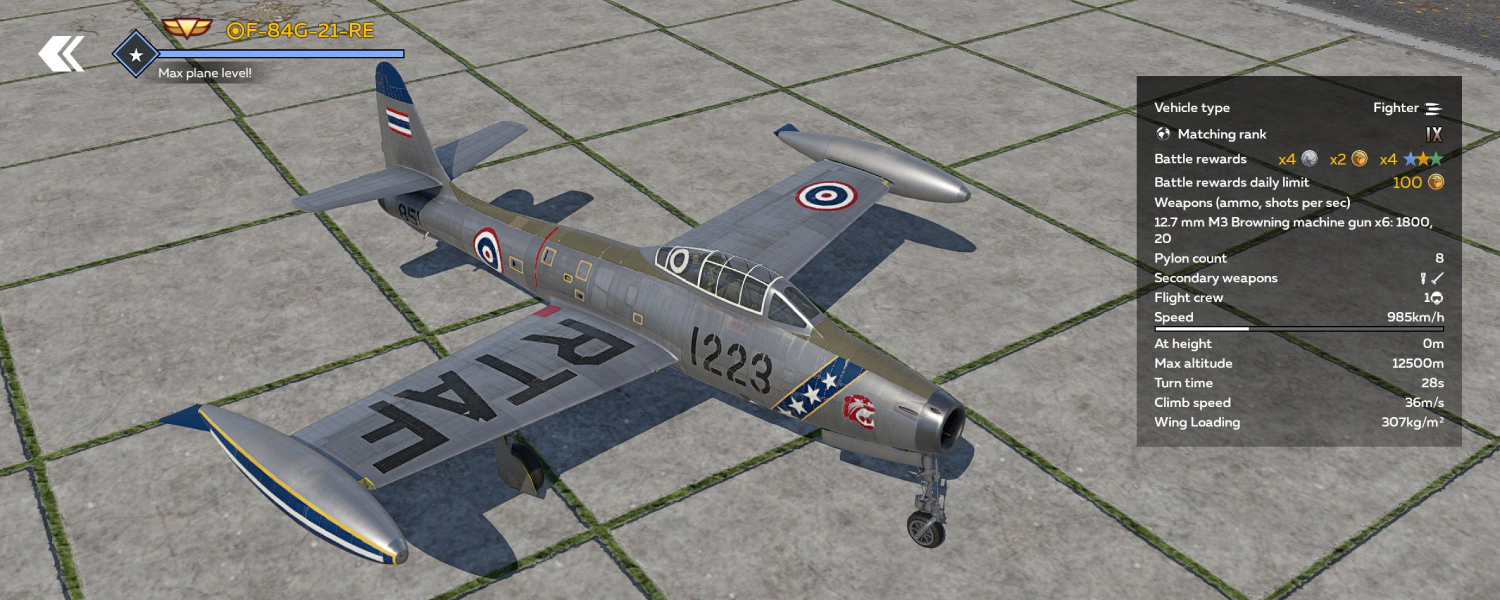
In battle
A highly successful American strike fighter, the F-84G Thunderjet, presented in Royal Thai Air Force camouflage. One of the defining traits of this early jet is its ability to achieve and sustain high speeds at medium and even low altitudes, where most competitors require significant height to unlock their full performance. The Thunderjet, however, does not. At high altitudes, the F-84G-21-RE remains competitive as well, outperforming all piston-engine aircraft and many jet fighters at its battle rating.
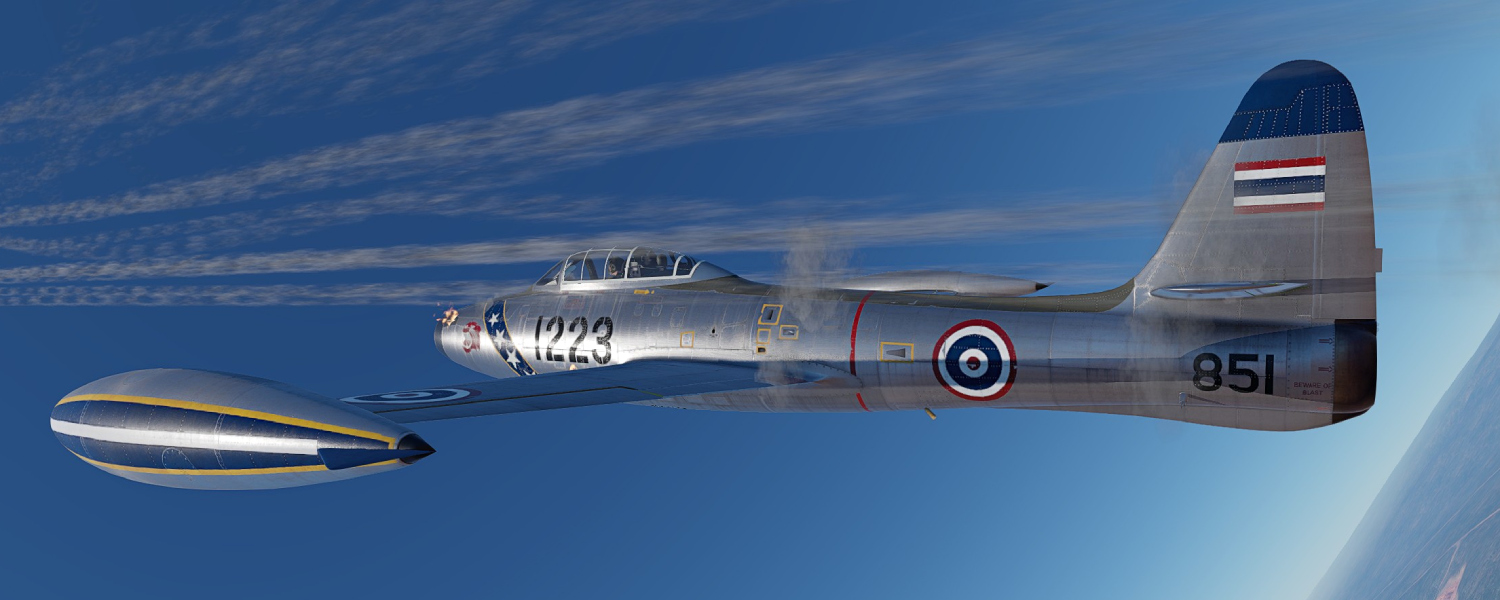
The F-84G-21-RE is very solidly armed. Its fixed forward armament consists of six reliable .50 caliber (12.7mm) Browning machine guns. A variety of ordnance for ground attack can be mounted on its hardpoints: bombs from 100 to 1000 lbs, HVAR rockets, and the massive Tiny Tim rockets.
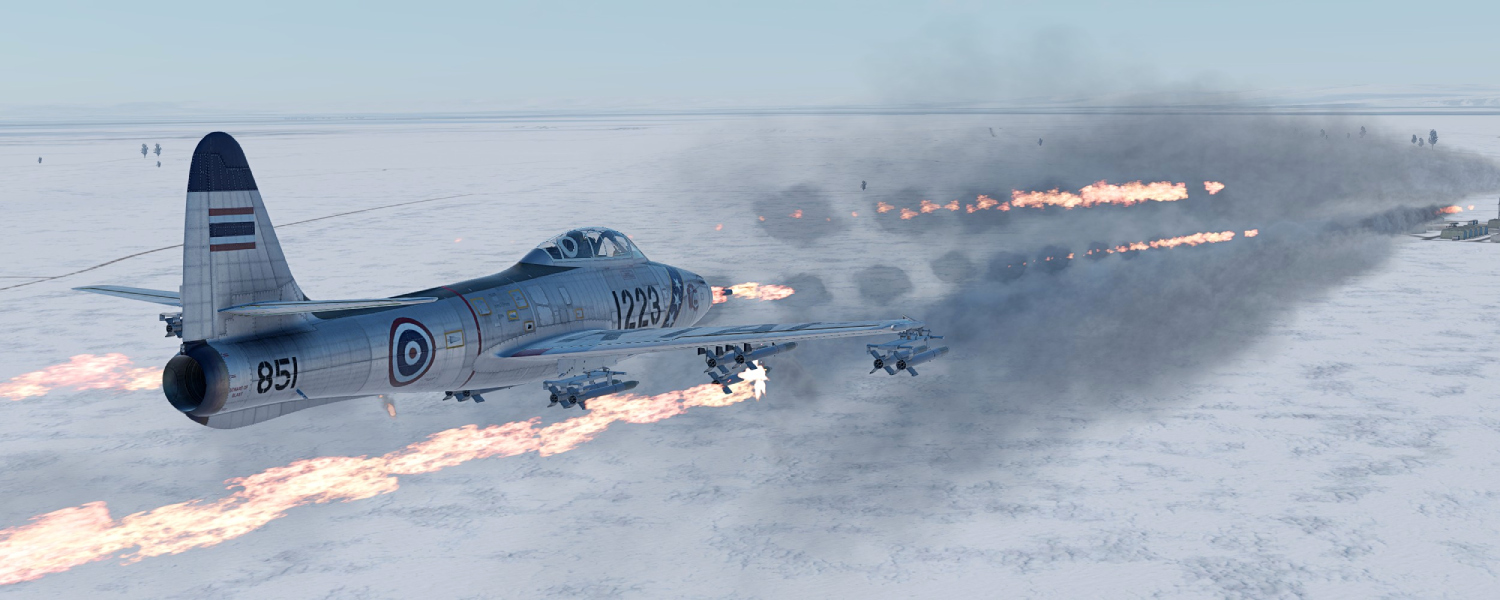
After releasing its bombs or firing rockets, the F-84G-21-RE can pursue fighters and attackers at low altitude or climb to engage targets at higher elevations. The Thunderjet’s main drawbacks are poor high-speed controllability and unimpressive maneuverability. As a result, ground attacks and strafing runs should be executed in single, decisive passes, avoiding prolonged turns or dogfights.
Seasonal Challenge
After completing the event tasks between January 13th and January 20th (ends at 07:00 GMT), you can receive the maximum discount on the Seasonal Offers!
Don’t miss the fantastic chance to buy great premium vehicles at a discount and receive bonus Big Trophy keys from the “Lightning Strike” season.