[Seasonal Offer] Unconventional Trio
Unique ground, naval and air vehicles – in seasonal offers only!
Seasonal Offers
Commanders! 🚩 From August 20th to August 27th, 2026 (ends at 07:00 GMT), as part of a Seasonal Offer, a new set of unique premium vehicles will be available to you. After completing special Seasonal Challenges, you will be able to purchase it with a maximum discount:
- In the Tank Campaign: BMPT-72 + 3 Keys for the Big Trophy from the “Thunder Blossom” season + Back-ups x5, Repair Kits x125, Medical Kits x100, Fire Extinguishers x50.
- In the Ship Campaign: SMS Erzherzog Franz Ferdinand + 4 Keys for the Big Trophy from the “Thunder Blossom” season + Smoke Generators x200 + Naval Supply x200.
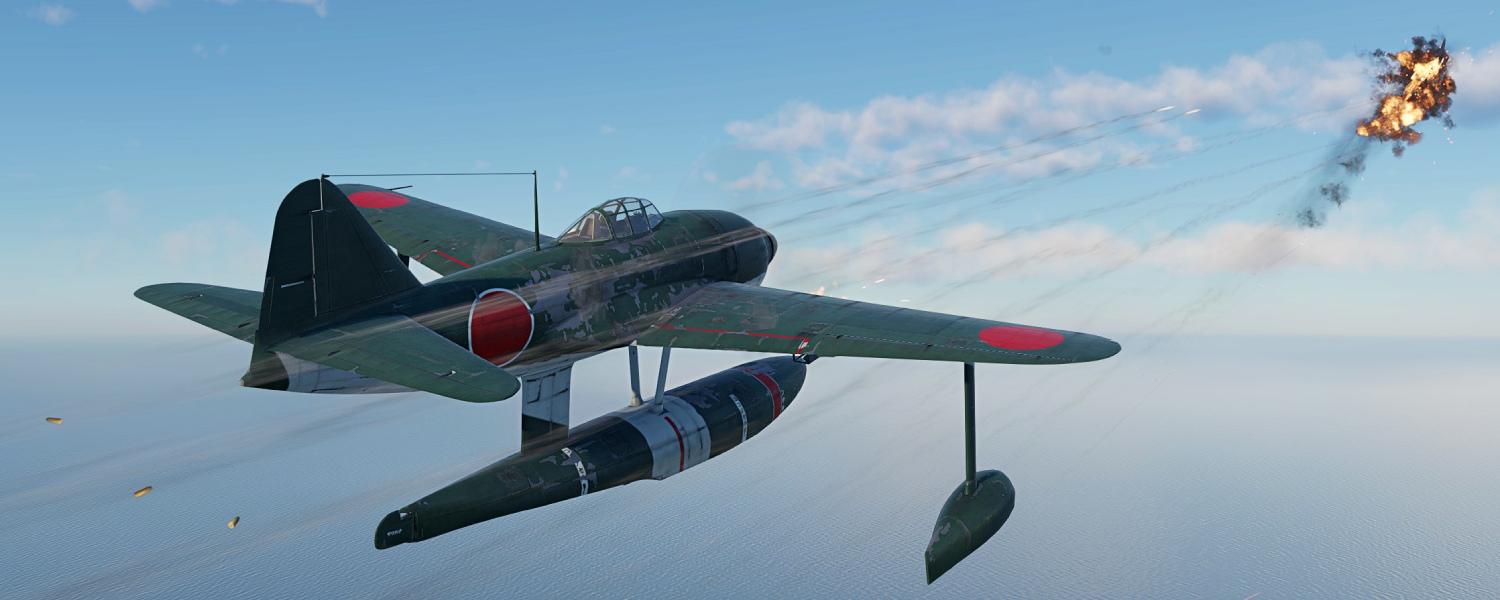
- In the Aviation Campaign: N1K1 + 1 Keys for the Big Trophy from the “Thunder Blossom” season + Back-ups x4.
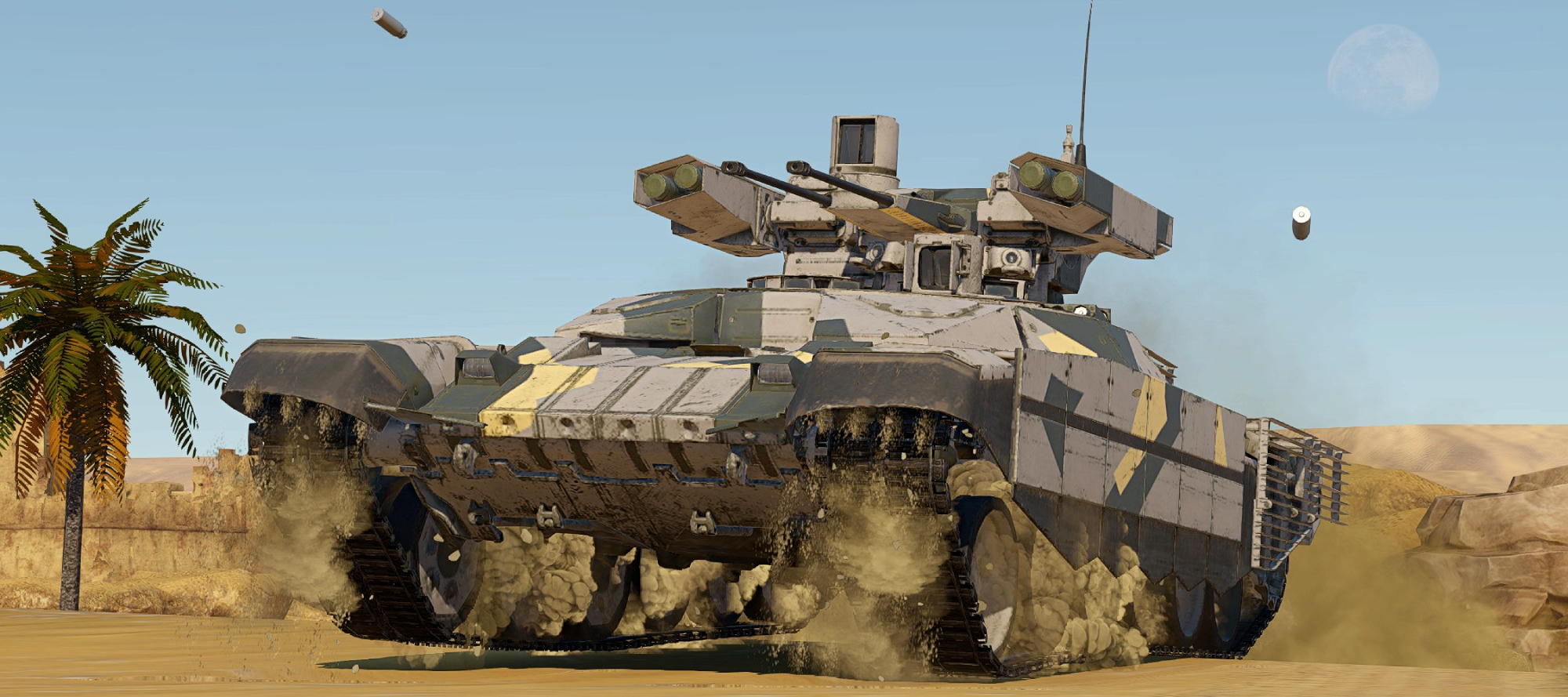
BMPT-72 (Rank XII)
Historical Note
The "Terminator" tank support fighting vehicle entered development in the mid-1980s, with state trials completed in 2006. Although recommended for serial production, it never entered service with the Russian Army within the planned timeframe. Production ultimately began in 2011 on the T-90 chassis, with the first vehicles delivered to Kazakhstan.
In 2013, a new variant emerged – the BMPT-72 "Terminator-2" based on the T-72 platform. It differed from the original in three key respects: greater commonality with the T-72 MBT, a reduced crew of three rather than five, and reinforced armor on the ATGM launchers. These changes improved survivability and reduced operating costs. The vehicle currently serves with the Russian Army and is exported to foreign operators.
Brief Overview
- Strengths: Good protection, effective ATGMs, and 30 mm autocannons.
- Weaknesses: Small crew and low reverse speed.
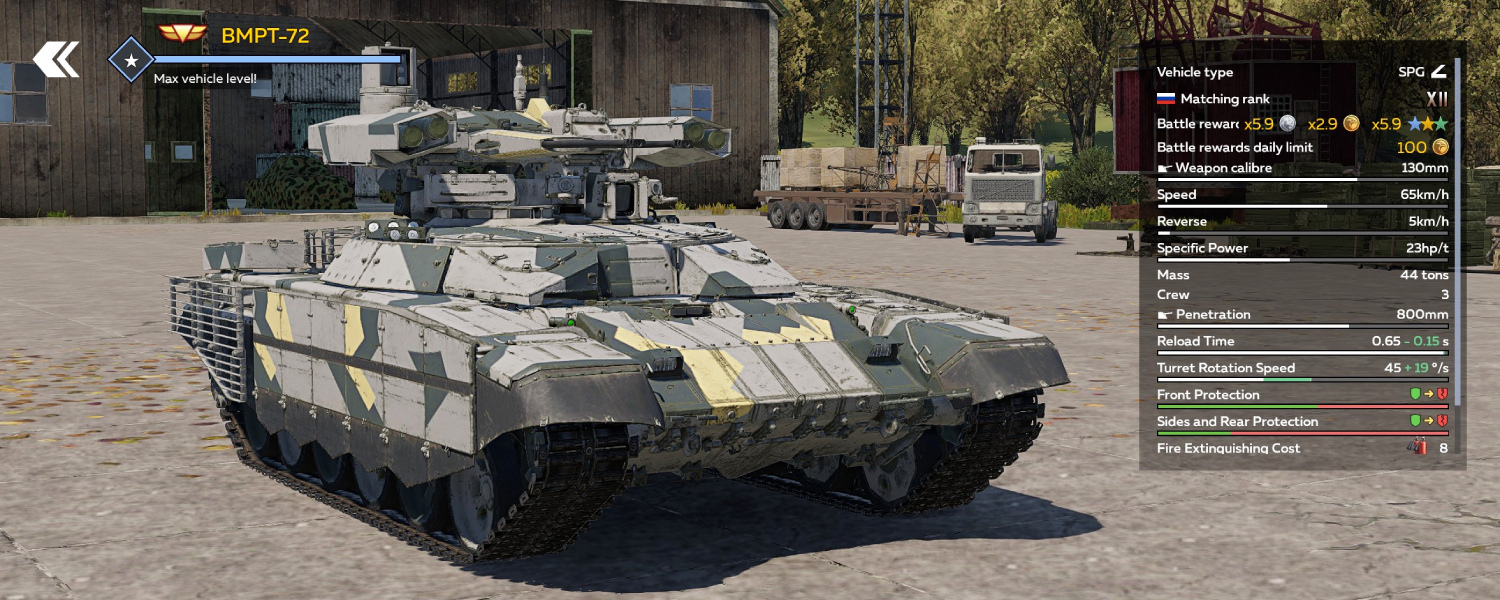
- Role in battle: A capable support vehicle that can operate independently. Exceptional protection for its class, combined with strong armament, makes the Terminator-2 one of the most formidable vehicles on the battlefield!
In Battle
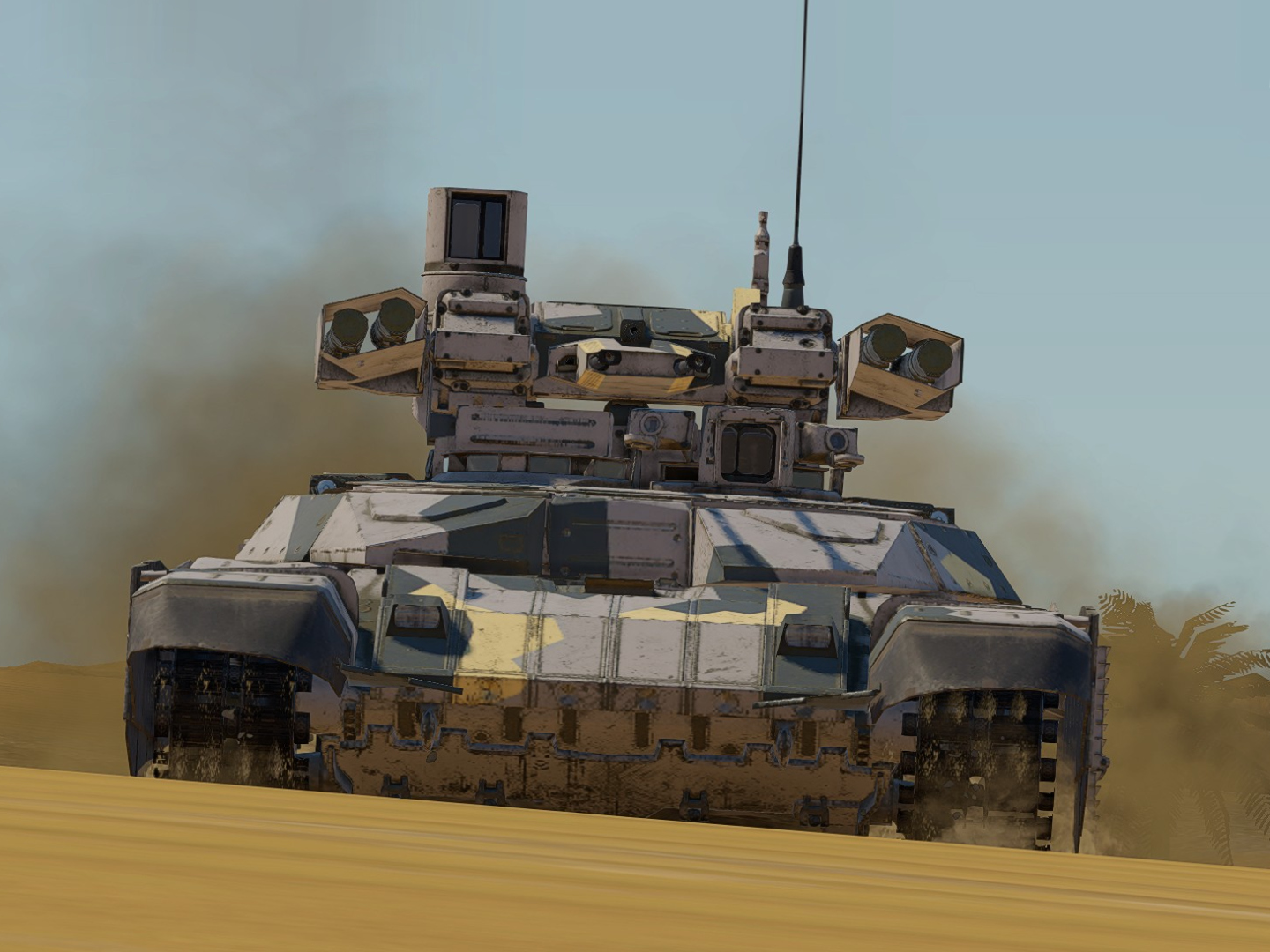
The defining characteristic of the BMPT series is the combination of tank-grade protection and powerful missile-and-gun armament. Built on the T-72 chassis, the Terminator-2 features composite armor reinforced with explosive reactive armor and slat armor – making it arguably the best-protected ATGM carrier in the game.
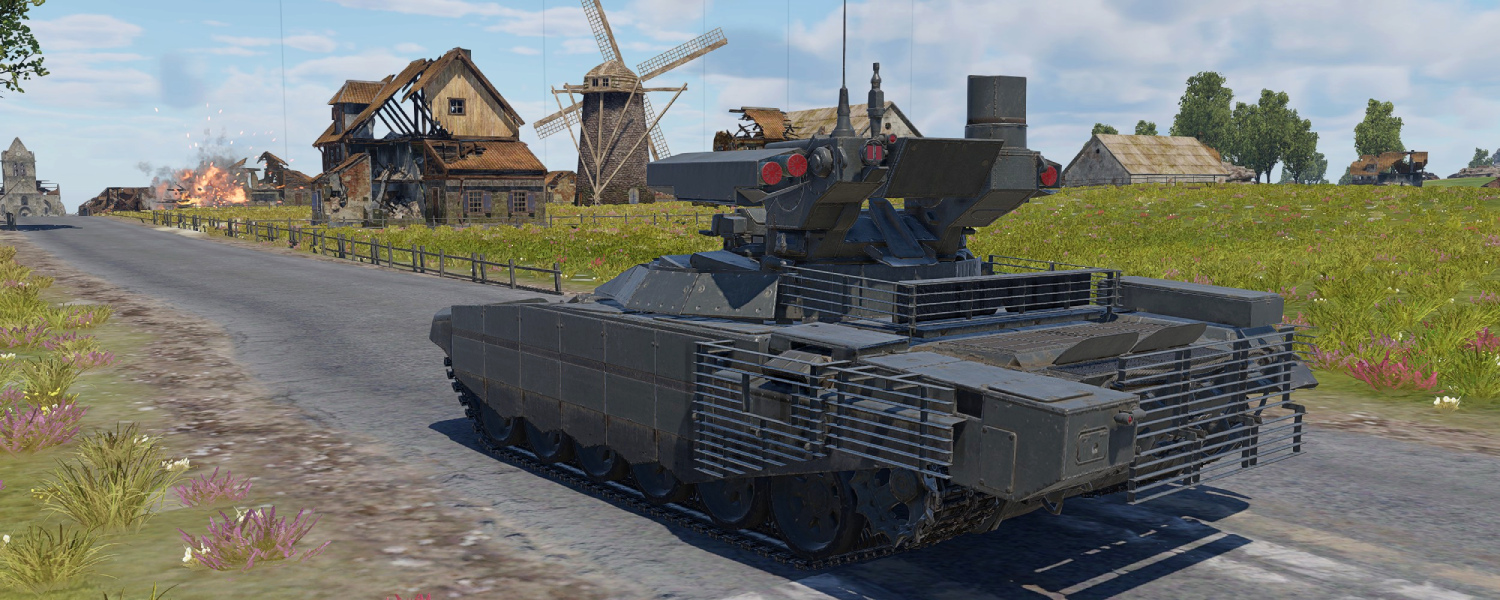
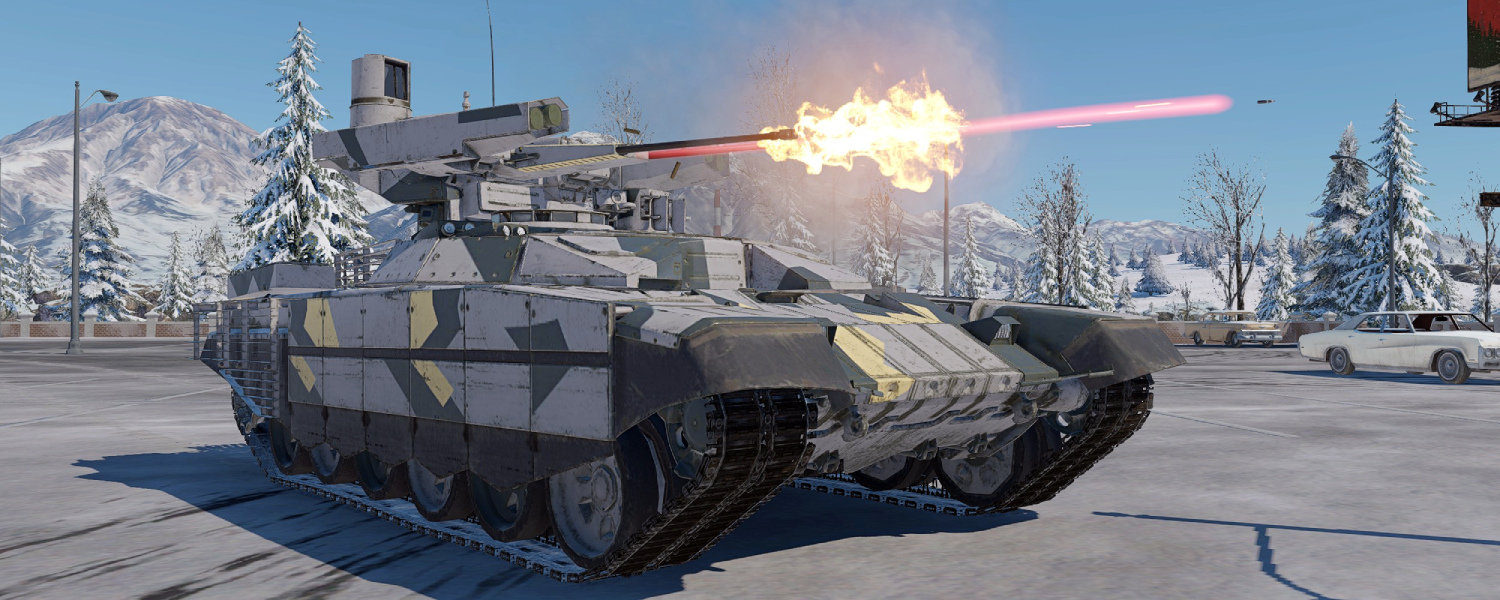
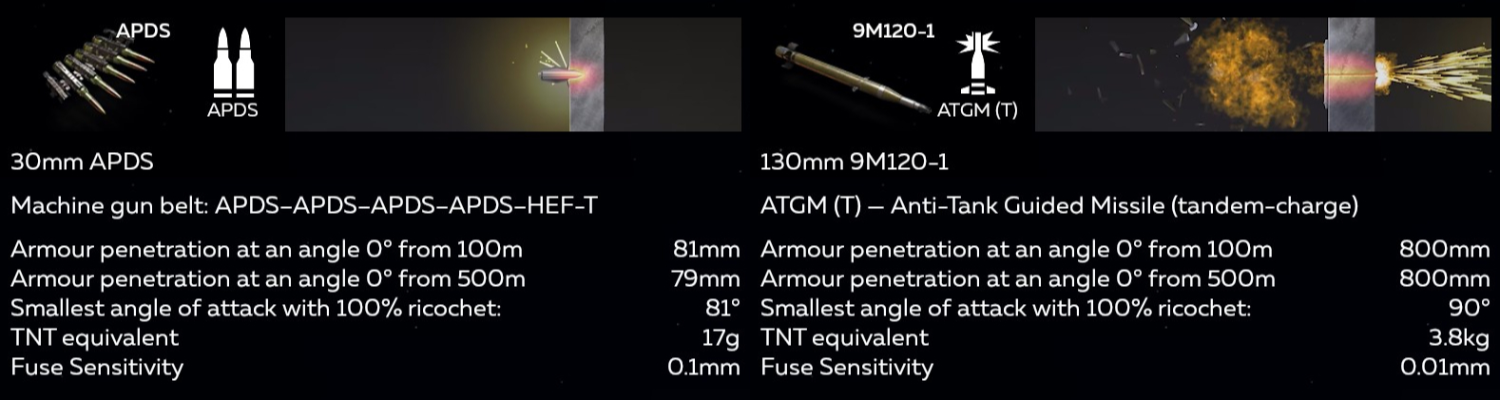
The combat module houses a pair of 30 mm autocannons with a broad ammunition selection: HEF-I rounds for light vehicles and aircraft, and APDS for more heavily armored targets. The primary weapon, however, is the Ataka ATGM, available with two warhead types – tandem for heavy armor and high-explosive for softer targets. The launch containers are protected by armored shrouds, while the engine-transmission compartment area is shielded at the rear and sides by additional slat armor.
View the characteristics of the BMPT-72’s shells:
View the characteristics of the BMPT-72’s shells:
One notable difference from the original Terminator is the crew reduction to three – a disadvantage in gameplay terms. The T-72 platform also passes on its negligible reverse speed, meaning a misjudged position or route can prove costly: retreating quickly behind cover will not be an option.
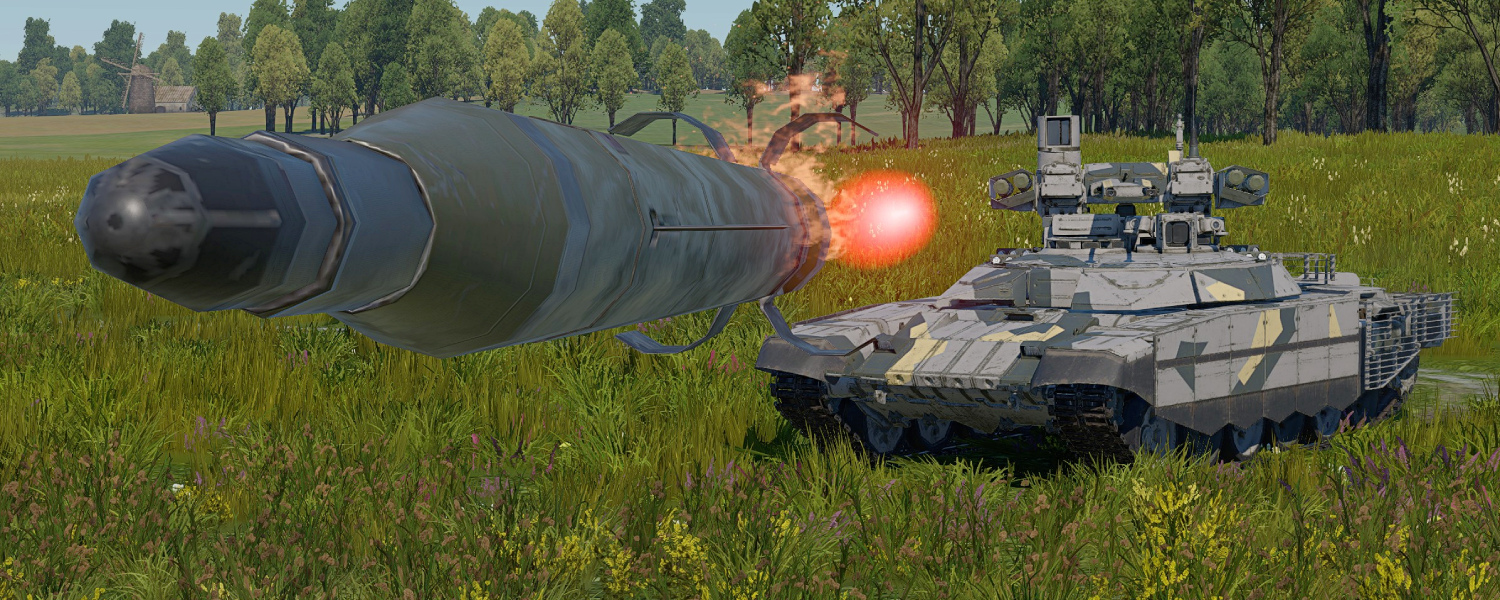
In all other respects, the BMPT-72 is an exceptionally effective vehicle in skilled hands, equally capable of supporting allies or operating independently.
SMS Erzherzog Franz Ferdinand (Rank III)
Historical Note
The Radetzky-class battleships were built in Austria-Hungary in the years preceding World War I. SMS Erzherzog Franz Ferdinand entered service in 1910, participating in training cruises until 1912 before seeing action in the Balkan Wars. During the blockade of Montenegro, the Radetzky-class ships launched seaplanes under combat conditions for the first time in history.
Following the outbreak of World War I, the ship took part in the defense of the German cruisers Goeben and Breslau. On May 24, 1915, Austria-Hungary declared war on Italy, and SMS Erzherzog Franz Ferdinand joined the dreadnoughts in the bombardment of Ancona. Throughout the war, the ship escaped combat damage entirely, suffering only a single collision with another Austro-Hungarian vessel. Following the armistice, she was seized by Italy, transferred between ports as a war prize, and even nominally recommissioned – before being scrapped in 1926.
Brief Overview
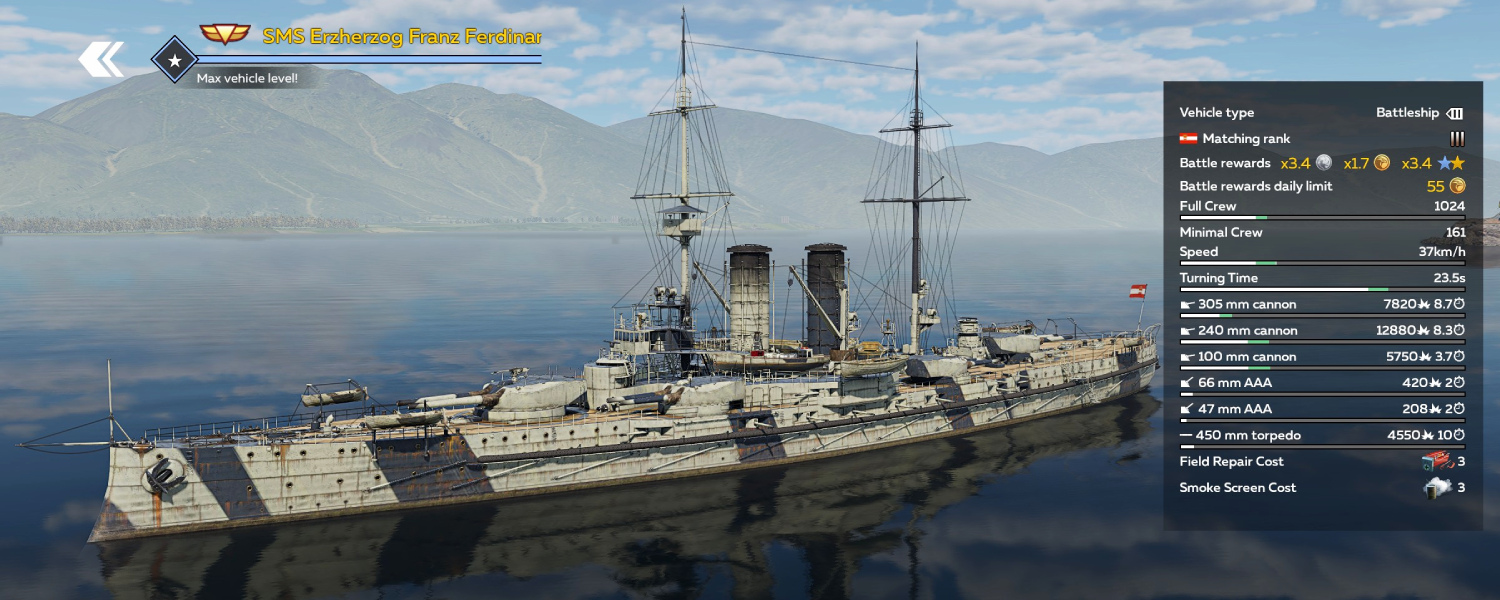
- Strengths: Large intermediate-caliber guns with high damage output, decent mobility for a battleship, and close-range torpedoes.
- Weaknesses: Relatively thin belt armor and weak penetration from the 100 mm guns.
- Role in battle: A balanced pre-dreadnought with impressive firepower and comparatively good mobility.
In Battle
The SMS Erzherzog Franz Ferdinand is one of the most ambitious and capable pre-dreadnought projects ever built. Designed specifically for operations in the Adriatic, the ship did not require large coal bunkers – and the displacement saved went directly into armament. The result was a main battery of four quick-firing 305 mm guns supported by eight 240 mm guns, paired with good speed for a ship of its class.
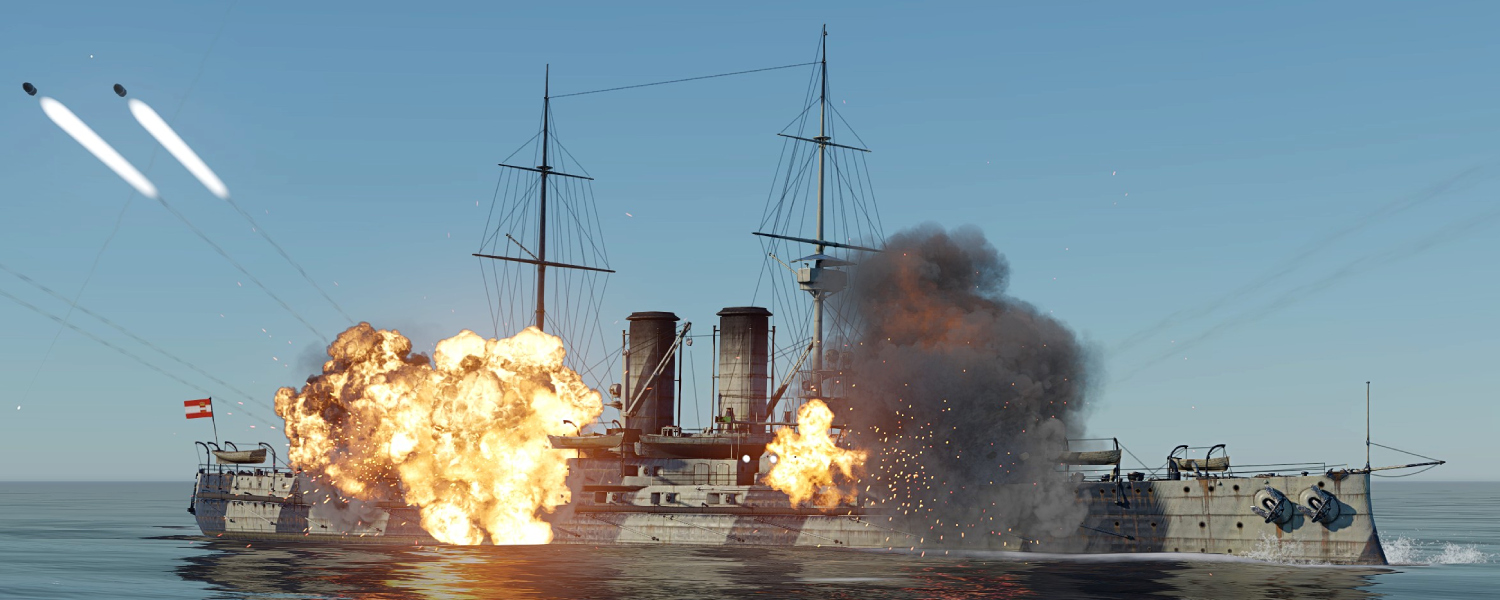
In battle, Franz Ferdinand may fall short of many dreadnoughts in armor and main battery count, but it compensates with a high rate of fire and solid mobility. While heavier opponents lumber between positions, Franz Ferdinand's guns will find gaps in their protection – and the ship itself will reach cover far sooner than any dreadnought.
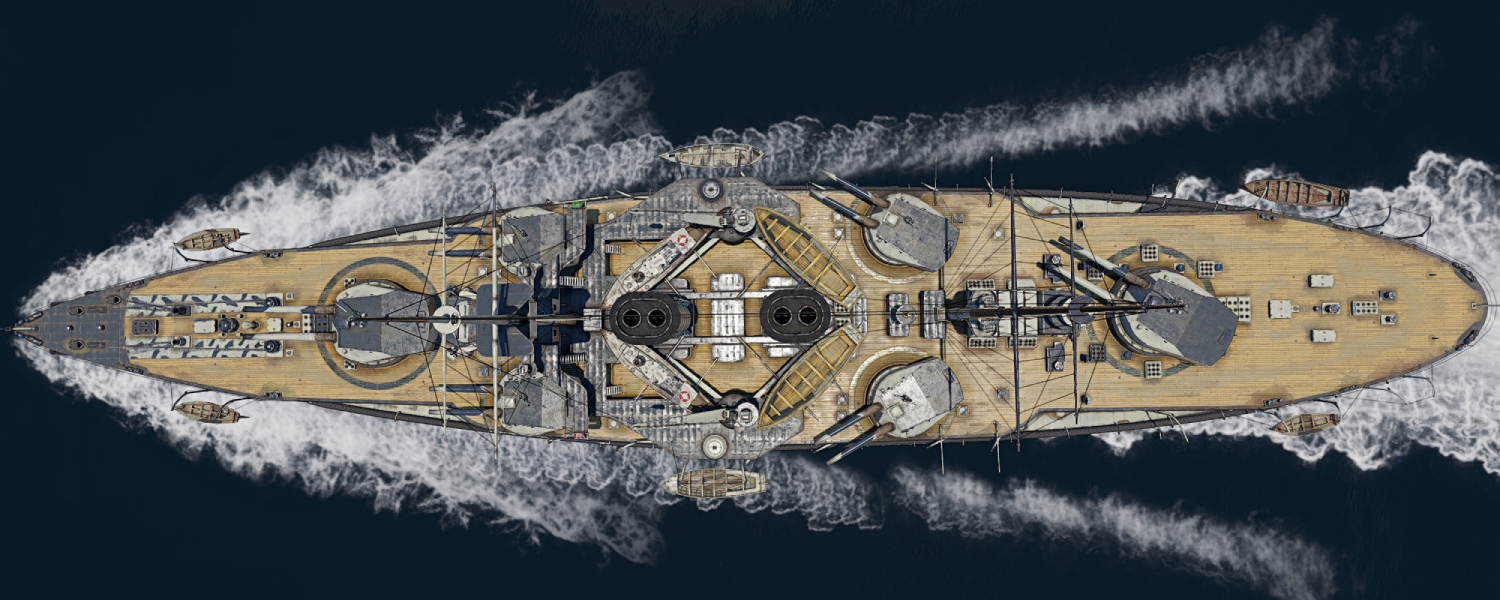
Its survivability is sufficient for active, initiative-driven combat, but it cannot absorb concentrated salvos of heavy caliber fire for long. Constant maneuvering and exploiting the rate of fire are the foundations of success in this vessel.
N1K1 (Rank II)
Historical Note
The N1K1 Kyōfū (meaning "Strong Wind") was a fighter seaplane developed by Kawanishi for the Imperial Japanese Navy in 1940, intended to support amphibious operations in areas without established airfields. Series production did not begin until 1943, by which time the nature of the war had fundamentally changed: Japan had shifted to a defensive posture, and floatplane fighters were no longer a priority.
The N1K1 saw limited service in Southeast Asia, over Okinawa, and on Lake Biwa, where crews encountered increasingly superior Allied fighters. Approximately 100 aircraft were built in total. The design served as the basis for the land-based N1K1-J Shiden army fighter, widely regarded as one of the finest Japanese fighters of the Second World War.
Brief Overview
- Strengths: Twin 20 mm cannons and machine guns; good maneuverability.
- Weaknesses: Floats limit maximum speed.
- Role in battle: Despite its bulky floats, the N1K1 is a highly maneuverable fighter with strong armament for Rank II – well suited to close-quarters dogfighting!
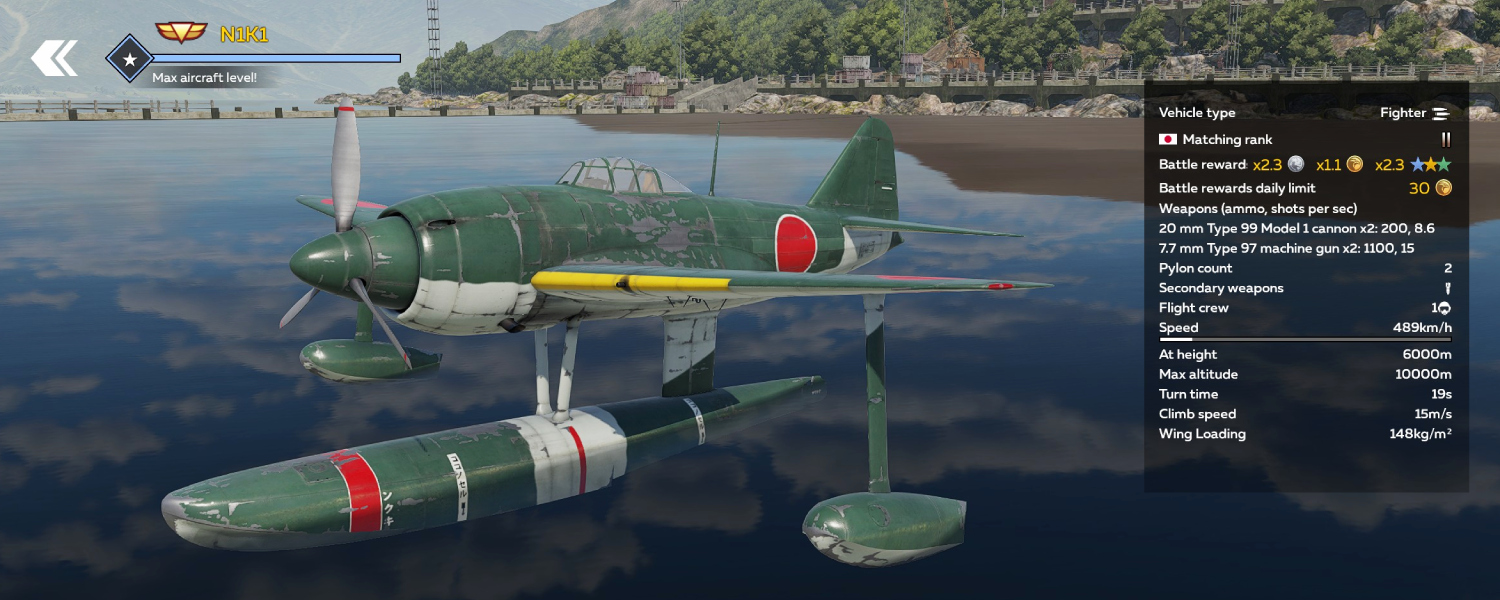
In Battle
At first glance, the N1K1 seems an unlikely arrival at Rank II of the Japanese aviation tree – a float-equipped seaplane that looks heavy and cumbersome. Appearances, however, can be deceiving.
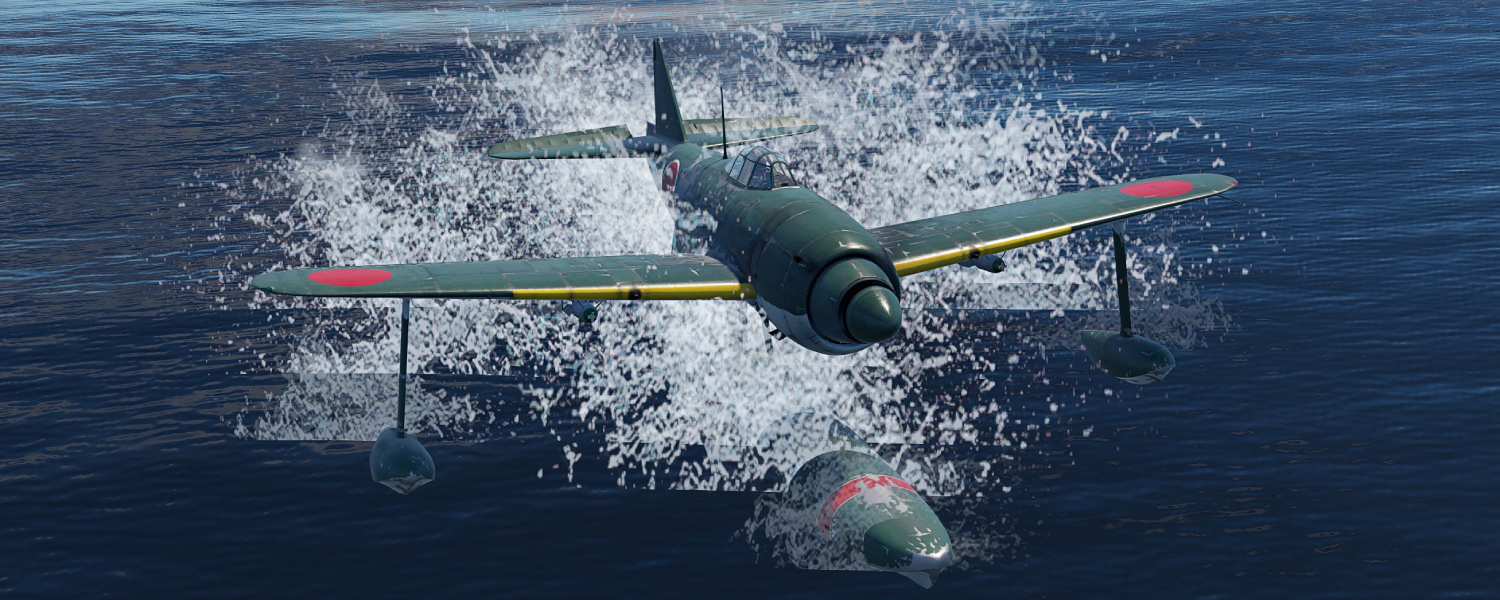
Even with its floats, this aircraft outturns most opponents in the horizontal, benefits from self-sealing fuel tanks, and carries solid armament: a pair of 20 mm cannons and two machine guns mounted in the wing consoles.
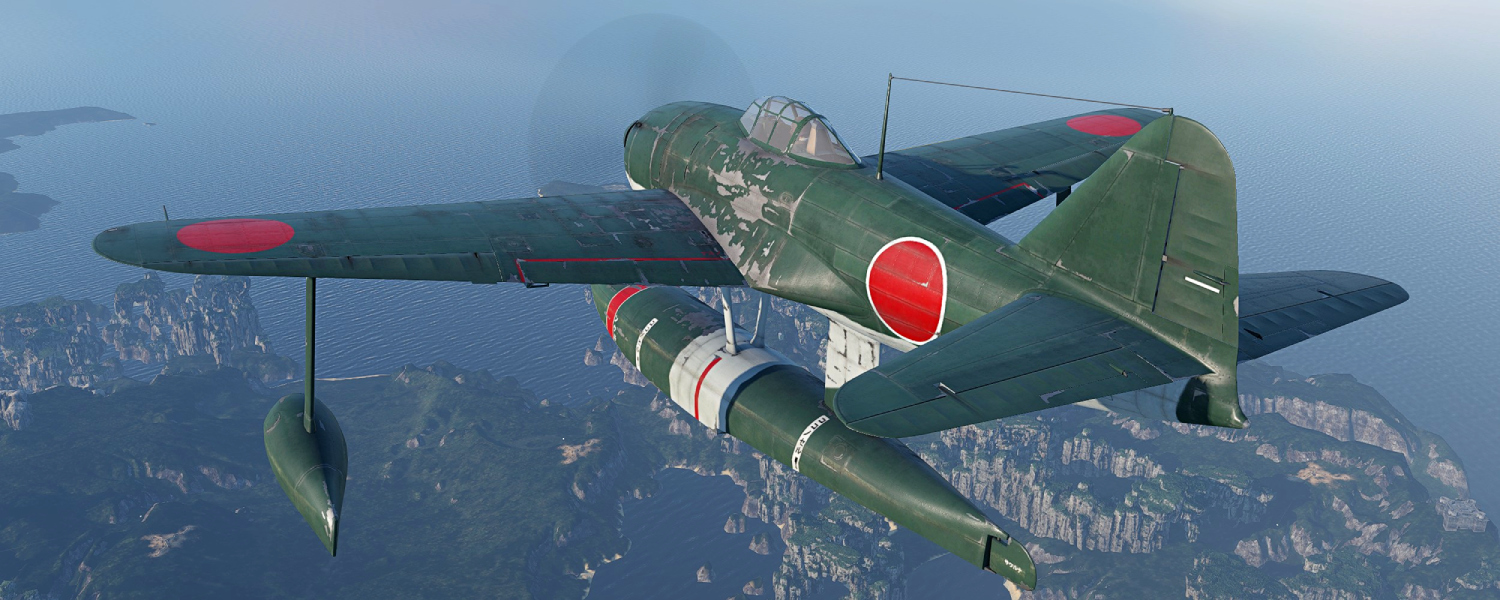
The N1K1's natural environment is low-altitude turn fighting. The bulky floats do bleed speed and accelerate energy loss in turns, making extended pursuits difficult and counterproductive. The better approach is to dive straight into the center of the action, where the N1K1's superior maneuverability and hard-hitting cannons give it a decisive edge.
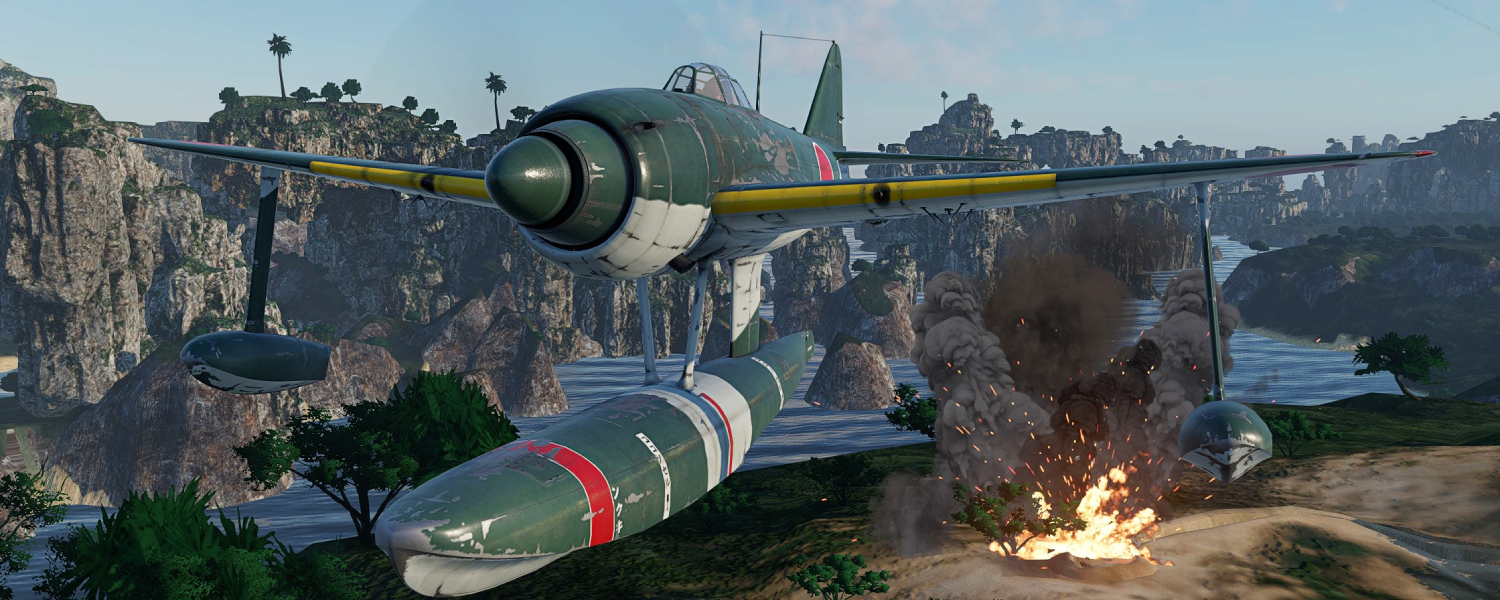
Unusual but highly effective, the N1K1 rewards pilots who favor tight turns and concentrated firepower. Its floats are no barrier to being a formidable opponent – and its combination of maneuverability and armament makes it an excellent choice for dogfighting against early-tier fighters.
Seasonal Challenge
After completing the event tasks between August 20th and August 27th (ends at 07:00 GMT), you can receive the maximum discount on the Seasonal Offers!
Don’t miss the fantastic chance to buy great premium vehicles at a discount and receive bonus Big Trophy keys from the “Thunder Blossom” season.